
Ngāpuhi had enjoyed economic benefits from their early contact with Europeans, and leaders such as Tāmati Wāka Nene and Hōne Heke Pōkai were keen to preserve this relationship. Both had converted to Christianity and supported the Treaty of Waitangi. Heke, the first signatory, had invited Lieutenant-Governor Hobson to ‘stay with us and be like a father’.
The Treaty of Waitangi was expected to cement the relationship with the British Crown and make Ngāpuhi prosperous. But optimism quickly turned to frustration. Hobson’s decision to move the capital from the Bay of Islands to Auckland in 1841 was a serious blow.
When the flagstaff was re-erected after the third attack on 19 January 1845, FitzRoy had it clad in iron and protected by a blockhouse. Nene also provided guards for the flagstaff.
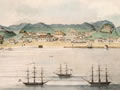
As tension mounted Kororāreka (Russell) was placed on a war footing. FitzRoy appealed to New South Wales for military aid. The sloop HMS Hazard, which had been sent from New South Wales after the first incident in July 1844, was instructed to return to the Bay. One hundred and forty soldiers, sailors and marines were now available to defend the town. Two hundred residents and crewmen of visiting ships were also armed.
Shortly before dawn on 11 March 1845, Heke and several hundred fighters moved on Kororāreka. One group, led by Te Ruki Kawiti, created a diversion at the southern end of the town, enabling Heke to seize the blockhouse defending the flagstaff. The offending pole was cut down for a fourth time.
Desultory fighting continued for the rest of the morning. Women and children were evacuated in the early afternoon. Soon afterwards the powder magazine at Polack’s stockade exploded and surrounding buildings caught fire. The troops were now also evacuated to ships anchored in the bay.
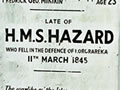
When Lieutenant G. Philpotts of the Hazard ordered the bombardment of Kororāreka, Māori began looting the town. The Anglican and Catholic churches were spared from destruction on Heke’s orders.
The looting and subsequent burning of Kororāreka shook the settler population. Some £50,000 worth of property (more than $6 million in 2017 values) was lost. There was panic in Auckland when the refugees arrived. Some settlers sold their land for whatever price they could get and fled the colony.
Why was Kororāreka lost?
Settlers and officials demanded an explanation of how professional soldiers and sailors had allowed Kororāreka to fall. Some pointed to divine retribution. As a ‘Gomorrah, the scourge of the Pacific’, the ungodly settlement had finally got what it deserved.
The size of the Māori force was inflated to at least 1000. In what was to become a feature of reporting on the New Zealand Wars, Māori casualty figures were similarly inflated, from 13 dead and 28 wounded to 34 and 68 respectively. The British lost 19 or 20 dead and 23 wounded.
Lieutenant Philpotts pointed a finger of suspicion at missionary Henry Williams, whose close relationship with Heke saw him accused of somehow betraying the town. Though FitzRoy dismissed this allegation as ‘utterly absurd’, rumours persisted throughout the Northern War that the missionaries were in some way to blame.
The military also came in for criticism. FitzRoy lambasted ‘the shameful conduct of those officers whose uselessness caused the loss and destruction of Kororareka’. The decision to abandon the town had been too hasty.
The conflict widens
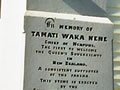
Nene and his supporters took no part in the fighting at Kororāreka, and Nene continued to talk to Heke in a bid to stop the conflict escalating. But fighting between the two main Ngāpuhi factions broke out in April. Historian James Belich has described this as ‘restrained feuding’ — no ambushes, no fighting at night — but the conflict intensified when Heke insulted Nene by accusing him of ‘fighting for blankets’.


