
After the British victory at Rangiriri in November 1863, Wiremu Tāmihana tried to negotiate peace. He sent his greenstone mere (club) to Cameron as a token of his good faith. But neither Grey nor the settler government saw any need to negotiate. Some dismissed Tāmihana’s offer as an attempt to buy the Kīngitanga time to construct a new defensive line.
Grey offered peace – if all land and arms were surrendered. There was some talk that ‘moderates’ within the Kīngitanga were ready to submit. These were men who had wanted to avoid war in the first place. But they were not willing to accept Grey’s terms. Tāmihana built a pā at Maungatautari, above the Horotiu (upper Waikato) River:
If the Governor follows me here, I shall fight. If not I shall remain quiet … But if the General goes to Waipa (to attack) the Ngati Maniapoto I shall be there.
Pāterangi
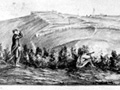
The electric telegraph line was extended from Queen’s Redoubt to Rangiriri, and kūpapa Māori helped open an overland supply route from Raglan to the Waipā River.
Ngāti Maniapoto leader Rewi Maniapoto had been against building the pā at Rangiriri. He had instead focused on the construction of a defensive line centred on Pāterangi in south Waikato, between Te Awamutu and the Waipā River. A series of fortifications at Te Rore, Pikopiko and Ōhaupō protected Māori from an attack from either the Waipā or Horotiu rivers. More importantly, unlike Meremere and Rangiriri, Pāterangi could not be outflanked by river. The complex consisted of 2 km of trenches, with critical junctions supported by redoubts.
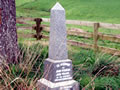
By early January 1864 Cameron had 7000 men south of Ngāruawāhia. Most were to maintain the supply lines for his strike force. On 28 January, 2100 men left camps at Whatawhata and Tuhikaramea. In addition to imperial troops there were Colonial Defence Force and volunteer cavalry and two companies of Forest Rangers. Pikopiko was bypassed and by lunchtime on the 29th Pāterangi was in sight. Ensign Gilbert Mair, Cameron’s interpreter, was struck by its impressive nature – Pāterangi ‘would be the most fearful place to storm’ – but observed that ‘the general has [no] intention of attacking it at all.’
Estimates of the size of the garrison Rewi was able to assemble vary. Māori evidence suggests that at its peak 2000 men from a dozen iwi were present. This was the largest Māori mobilisation of the war, but their numbers were still insufficient to both man the pā and harass Cameron’s force. Hoping Cameron would attack as he had done at Rangiriri, the garrison became frustrated with his cautious strategy. For three weeks artillery shelled the pā occasionally and there was some long-range sniping. Māori referred to this period as ‘Maumau Pauru’ (‘waste of gunpowder’).
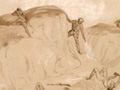
On 11 February some of the Māori at Pāterangi attempted to force the issue by attacking a party of soldiers at an advanced camp at Waiari. Māori lost about 30 men; six were killed on the British side. For his actions here Captain Charles Heaphy of the Auckland Volunteer Rifles was later awarded a Victoria Cross, the first member of a locally raised or colonial military unit in the British Empire to be so recognised.
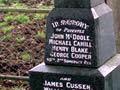
Cameron remained patient. The Avon and the newly arrived Koheroa had both grounded several times in the shallow Waipā River, and sufficient supplies for an advance had not arrived until 17 February 1864.
Rangiaowhia
At 11 p.m. on Saturday 20 February 1864, two Māori, Himi Manuao and John Gage, guided Cameron and more than 1200 of his men past Pāterangi without alerting lookouts stationed less than 1500 m away. Next morning the leading elements of this force suddenly appeared before Rangiaowhia.
With its fighting men still at Pāterangi, the settlement was virtually undefended. Colonel Marmaduke Nixon’s Colonial Defence Force Cavalry of 88 men arrived first, with Captain Gustavus von Tempsky’s company of Forest Rangers close behind. The inhabitants sought cover. Some took refuge in the two churches while many ran for their whare (houses).
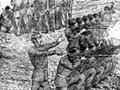
A cavalryman was shot outside one of the whare. The building was surrounded and two ranks of men began firing. An invitation to surrender was answered with a volley. Shots fired from close range passed over the heads of those lying on the sunken floor of the whare. Nixon stepped forward and fired into the house, he receiving wounds from which he was to die several months later. Another trooper was shot while trying to retrieve the body of a fallen comrade.
Gustavus von Tempsky and his Forest Rangers now joined the fighting. Whether accidentally or by design, the thatch of the building was set alight. An elderly man came out with a white blanket raised above his head. Clearly unarmed, he was killed by a hail of bullets despite an officer’s order to ‘spare him’. Perhaps enraged by the deaths of some of their comrades, soldiers continued firing into the house. Two more Māori attempting to escape from the fire met the same fate.
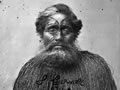
The bodies of seven Māori were found in the gutted ruins. Historian David Green thinks that what happened at Rangiaowhia that morning was not ‘a premeditated massacre but a breakdown of discipline among troops who had psyched themselves up to face much stronger resistance.’
Both Chris Pugsley and James Belich see the bypassing of Pāterangi as the decisive military act of the entire war. But as Belich points out, it was overshadowed by the events that unfolded next morning. The loss of Rangiaowhia’s resources was a severe economic setback for the Kīngitanga and a major blow to its morale.
Cameron had learnt from previous encounters and showed at Pāterangi that it was better to outflank Māori positions than to assault them head-on. The Kīngitanga force had been unable to make Cameron fight on their own ground and lacked the manpower to hold a major defensive position for long enough to frustrate the British into rash action. An end to Māori resistance in the Waikato basin was now only a matter of time.
Hairini
After attacking Rangiaowhia, Cameron withdrew to Te Awamutu to await the Kīngitanga response. When Rewi Maniapoto heard of the attack on Rangiaowhia he moved 400 fighters to the Hairini ridge, between Te Awamutu and Rangiaowhia. Here a defensive position was improvised to protect Rangiaowhia from further attack. Hairini presented Cameron with a rare opportunity to fight his opponents in the open. A force of 1200 men with two 6-pounder Armstrong guns marched from Te Awamutu on 22 February to confront Rewi’s men.
While one of Tempsky’s Forest Rangers described the initial action as ‘as pretty a bit of hot firing as I have ever seen’, Rewi’s position was no match for a concerted British attack. Rangiaowhia was occupied once more, this time without opposition. Wholesale looting occurred, with the Forest Rangers in particular helping themselves to anything they could lay their hands on.
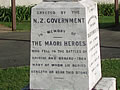
Hairini had been fortified to buy time while people and supplies were evacuated from Rangiaowhia and the Pāterangi line. This was the only fighting in which Wiremu Tāmihana, usually a mediator and advocate for peace, was personally involved: ‘for the first time my hand struck, my anger being great about my dead, murdered, and burnt with fire, at Rangiaowhia’.
From Hairini Tāmihana returned to his pa, Te Tiki-o-te-ihinga-rangi, on Maungatautari above the Horotiu (upper Waikato) River. In April, after the battle at Ōrākau, he and his people quietly abandoned this pā and returned to Peria, near Matamata. He wrote again to Grey and to other Māori leaders, seeking peace negotiations. When fighting shifted to Tauranga later in April, Tāmihana’s offer to mediate was ignored.
According to Pugsley, Hairini ‘should have marked the end of the Waikato campaign’. But it did not. ‘There was still yet one tragedy to enact at Orakau’.


