
The rescue of Betty Guard and her two children from Ngāti Ruanui in the spring of 1834 involved the first action by British troops on New Zealand soil. A British House of Commons inquiry into the affair in 1835 criticised what it described as the use of excessive force by the rescue party.
The wreck of the Harriet
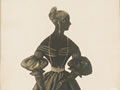
In April 1834 the whaler John (Jacky) Guard, his wife Elizabeth and their two children returned from a trip to Sydney aboard the Harriet, commanded by Captain Hall. On the 29th the barque was caught in a gale and driven ashore near Rāhotu on the Taranaki coast.
In true survivor style the castaways made tents from the ship’s sails. Several days later, they were attacked by a group of Taranaki Māori who plundered the wreck. Then Ngāti Ruanui, perhaps aggrieved at the lack of booty, attacked the party. In the ensuing struggle, 12 of the Harriet’s crew were killed, including Betty’s brother. Betty herself narrowly escaped death.
The Guards and a number of others were captured. After two weeks Jacky and several other men were released on the understanding that they would return with a cask of gunpowder as ransom for the rest of the party. They eventually reached Sydney, where Guard secured the support of Governor Bourke for the rescue of the captives.
For the four months until Jacky and the rescue party returned, Betty was under the protection of a chief, Oaoiti. According to some accounts she was well treated and lived as Oaoiti’s wife. Eyewitnesses to her rescue described her as calm and collected.
Settler woman savaged in brutal attack!
A sensationalised account of Betty’s capture that appeared in the Sydney Herald on 17 November 1834 emphasised Māori savagery:
[The Maori] stripped her and her children naked, dragged her to their huts, and would have killed her, had not a Chief’s wife kindly interfered on her behalf, and when the bludgeon was raised with that intention, threw a rug over her person, and saved her life…. They afterwards delivered the youngest child [Louisa] to the mother, and took the other away into the bush, and Mrs. Guard did not see it [John] for two months after.
Betty Guard also described how she ‘saw the Natives cut up and eat those they killed belonging to the Harriet’.
The rescue
Jacky Guard may have wanted Māori punished not just for this action but also for earlier incidents. The previous year Māori had pillaged his ship Waterloo after it ran aground on Waikanae beach. Also, three Māori workers at his station at Kākāpō Bay in Cook Strait had been killed and eaten by a Ngāi Tahu taua. The capture of his family was the last straw, and the desire to teach Māori a lesson was no doubt uppermost in Guard’s mind when he approached Bourke for support.
The man-of-war HMS Alligator and the colonial schooner Isabella arrived in Taranaki in September 1834 with a detachment of 60 men from the 50th Regiment. These soldiers were the first British troops to come into armed combat with Māori. Jacky Guard and some of his men accompanied the party.
Ngāti Ruanui assumed that the Europeans had come to negotiate the release of the captives and that, as was customary, they could expect something in exchange. Instead, Oaoiti was bayoneted and captured. Captain Robert Lambert, commander of the Alligator, had a firm no-ransom policy.
Four days later, on 25 September, Betty and her baby daughter were located at Te Namu pā. After the pā was attacked and burnt, Betty and Louisa were given up in exchange for Oaoiti. John Guard junior had been taken to the nearby pā of Waimate. The Alligator and Isabella bombarded this for three hours on 8 October before landing a strong force with a 6-pounder gun. John junior was grabbed from an elderly chief who was then summarily shot. The Sydney Herald’s account was slightly different:
One of the sailors reached the boy first and, finding him fastened to the man’s back by an old mat, took out his knife, and securing the boy, deliberately drew his knife across the man’s throat.
John junior’s rescue sparked a full-scale engagement. The Sydney Herald continued:
[F]inding the child safe, [the crew of the Harriet] now determined to take full revenge for the murder of their shipmates, and there being about 103 natives on the beach, we fired on them; and the soldiers on the hill supposing that orders had been given for firing commenced a discharge of musketry upon them.
Fighting continued for several days as rough seas delayed the re-embarkation of the troops.
The aftermath
In 1835 a Committee of the House of Commons condemned the use of excessive force against Māori during the rescue. Humanitarian groups such as the Church Missionary Society (CMS) protested long and loud about the Harriet affair, which they saw as evidence that unrestrained colonisation must be avoided in the interests of Māori. A petition organised by the CMS and the Wesleyan Missionary Society in 1837 asked the British government to do more to protect Māori.
The attitudes of men like Jacky Guard, who had a less-than-flattering reputation before this event, perhaps confirmed the fears of the humanitarian lobby. When asked how he believed Māori could be civilised, Guard is reputed to have said:
How would I civilise them? Shoot them to be sure! A musket ball for every New Zealander is the only way of civilising their country.
Louisa Guard died in early 1835, possibly as a result of injuries suffered in the initial skirmish. According to one account, Betty gave birth to ‘rather dark’ twins, fuelling rumours that Oaoiti was the father. However, it was also reported that she had a second son by Jacky in late 1835. She returned to Kākāpō Bay with her family early the following year, gave birth to another six children and lived until 1870.


