
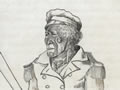
In 1830 Captain John Stewart of the brig Elizabeth made an arrangement with Ngāti Toa leader Te Rauparaha to ferry a taua (war party) of 100 warriors from his base on Kāpiti Island to Banks Peninsula. Te Rauparaha wanted to surprise his Ngāi Tahu enemies and avenge the killing and eating of several Ngāti Toa chiefs at Kaiapoi in 1829. Te Pehi Kupe had suffered the ultimate insult when his bones were made into fish-hooks. Te Rauparaha was keen to reassert his mana over his southern rivals.
In return for his services, Stewart would receive a cargo of flax. Although a business partner had been killed by Ngāi Tahu in 1824, Stewart’s motivation in 1830 was primarily economic.
A southern Trojan Horse
The arrival of a European trading ship would not have raised any particular alarm among Ngāi Tahu. Stewart lured the chief Te Maiharanui (Tama-i-hara-nui) aboard by offering to trade flax for muskets. Once they were aboard, Te Rauparaha and his men seized the chief, his wife and daughter. Ngāti Toa warriors attacked and destroyed Te Maiharanui’s settlement, Takapuneke. Several hundred were killed and dozens enslaved.
The brig returned to Kāpiti with Te Maiharanui and his family held captive. Rather than see his daughter enslaved, Te Maiharanui strangled her and threw her overboard. Once on Kāpiti, Te Maiharanui suffered death by slow torture at the hands of the widows of the Ngāti Toa chiefs slain at Kaiapoi; his wife met the same fate.
British law and order
Captain Stewart’s actions caused great concern among the missionaries, who were struggling to make progress in New Zealand. They felt that his participation in an ongoing dispute between tribes sent all the wrong messages to Māori about the effects of European contact.
The incident also highlighted the fact that New Zealand was a kind of judicial black hole. Governor Ralph Darling of New South Wales put Stewart on trial in Sydney as an accomplice to murder. In keeping with contemporary European attitudes, however, Ngāi Tahu were deemed ‘incompetent’ to act as witnesses because they were ‘heathens’. As a result, Stewart and his crew escaped punishment despite subsequent efforts to bring them before English courts.
The fact that no Europeans were killed in this incident meant that most Europeans took little interest in it. It did intensify demands, though, from humanitarian groups such as the Church Missionary Society for the British Colonial Office to intervene in New Zealand.
In 1832, with the agreement of the British government, New South Wales appointed James Busby as British Resident, a position equivalent to a consular officer. Busby arrived in New Zealand in May 1833 to watch over British interests. It was an impossible task, with virtually no budget and no real authority; even the New South Wales government sometimes took action in New Zealand without consulting him. Busby rarely went far from the Bay of Islands and was on bad terms with New South Wales Governor Sir Richard Bourke and some of the missionaries. The Colonial Office looked forward to replacing him with someone more able.


