
‘The scourge of the Pacific’?
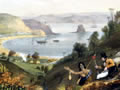
The missionaries divided the Europeans who came to New Zealand in the early 19th century into two groups: the agents of virtue (themselves) and the agents of vice (almost everyone else). Most Europeans who arrived on these shores in this period were here to exploit the country’s natural resources – seals and whales, then timber, flax and fisheries. The arrival of British and American sperm whalers from the early 1820s saw Kororāreka (later renamed Russell) in the Bay of Islands become for a time the biggest whaling port in the southern hemisphere. Here men and vessels could ‘refit and refresh’. Sometimes a dozen or more ships would be at anchor, with several hundred men ashore. Kororāreka became a significant point of contact between Europeans and Māori, Ngāpuhi in particular. Some Māori worked on ships and made regular trips across the Tasman, while others supplied crews with pork, potatoes and other goods and services. As both exports and imports grew rapidly, Kororāreka became increasingly important to the merchants and capitalists of New South Wales.
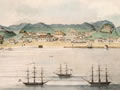
Men of many nationalities and backgrounds were thrown together in Kororāreka. Whalers, other seafarers and merchants mixed with adventurers, deserters and escaped convicts from Australia. Hard men used to hard living were found in all 19th-century frontier societies. In Adventure in New Zealand (published in 1845), Edward Jerningham Wakefield presented a relatively sympathetic view of whalers. An admirer of their ‘active, hard-working lifestyle’, he summed up their character as ‘the frankness and manly courage of the sailor mingle[d] with the cunning and reckless daring of the convict’. Though prone to drunkenness (a vice Wakefield shared) and with a ‘general inclination to vice and lawlessness’, they redeemed themselves through their ‘many generous and noble qualities’.
The missionaries, however, were troubled by what they saw in Kororāreka. Prostitution was one of the Bay of Islands’ main industries. Sex paid for the purchase of many things, including muskets. Short-term ‘marriages’ were frequently negotiated, and many local women bore the tattoos of their itinerant lovers.
In 1834 Edward Markham was told that 30 to 35 whaling ships would
come in for three weeks to the Bay and 400 to 500 Sailors require as many Women, and they have been out [at sea] one year. … These young Ladies go off to the Ships, and three weeks on board are spent much to their satisfaction as they get from the Sailors a Fowling piece [shotgun], … Blankets, Gowns &c as much as they would from the Missionary in a year.
Another more judgmental visitor described Kororāreka as a ‘Gomorrah, the scourge of the Pacific, which should be struck down by the ravages of disease for its depravity’.
The importance of this area was reflected in the choice of nearby Okiato (the original Russell) as New Zealand’s first capital following the signing of the Treaty of Waitangi in 1840. When Hobson moved his capital to Auckland in 1841 the local Ngāpuhi economy was seriously undermined. This was one factor in the outbreak of the Northern War on 11 March 1845, when most of Kororāreka was accidentally destroyed by fire.


